In an era marked by authoritarian resurgence, systemic oppression, and the erosion of democratic norms, the role of art has never been more critical. Cuban-American artist Tania Bruguera, a pioneer of arte de conducta (behavior art), has long championed the idea that art must be political—not as a choice, but as a necessity. Her iconic performance Tatlin’s Whisper #6, originally staged during the 2009 Havana Biennial, has become a global symbol of resistance, free expression, and the power of collective action.
This piece explores why Bruguera’s work—and her unwavering belief in art’s political agency—remains more relevant than ever. From the streets of Havana to Times Square, her performances serve as both a thermometer and a catalyst for change, challenging audiences to confront the fragility of freedom and the urgency of solidarity. We delve into her philosophy, the intersections of art and activism, and why, in times of crisis, art is not just a reflection of society—it is society’s most potent weapon.
—
Tania Bruguera’s Tatlin’s Whisper #6 is not merely a performance; it is an experiment in collective courage. The work’s deceptively simple premise—a raised platform, a microphone, and a one-minute limit for each speaker—belies its profound implications. First presented in Havana, where censorship and state violence were palpable, the piece became a real-time gauge of political repression.
How does it work? Participants are invited to step onto the platform and speak freely for one minute. In Cuba, the silence that often followed was as eloquent as the words spoken. The work’s title references Vladimir Tatlin’s Monument to the Third International, an unrealized architectural dream meant to symbolize the Bolshevik Revolution. Like Tatlin’s unfinished monument, Tatlin’s Whisper #6 embodies the fragility of revolutionary ideals—how easily they can be co-opted, suppressed, or left unfulfilled.
Bruguera explains it best: “It is above all a thermometer of the political moment. It doesn’t turn out well or badly; it simply turns out. What exists is what will be seen.“
This concept, which she calls political-timing-specific art, underscores that art’s power lies not in its aesthetic value alone, but in its ability to expose the conditions of its own existence. When Tatlin’s Whisper #6 was staged in Valencia, Spain, prior to its Havana debut, it failed—not because of poor execution, but because there was no political friction. In a society where free speech was taken for granted, the performance lacked urgency. It was in Havana, where the fear of punishment was real, that the piece became a site of both resistance and revelation.
—
Dictatorships are built on control—control of information, control of narrative, control of fear. And yet, history has shown that artists are among the first targets of authoritarian regimes. Why? Because art exposes the cracks in the system.
Bruguera’s work has made her a target of the Cuban regime, which arrested her in 2014 for attempting to stage Tatlin’s Whisper #6 in Havana’s Plaza de la Revolución. Her crime? Inviting Cubans to exercise their right to free speech. The regime’s response—arrest, censorship, and intimidation—was not just a suppression of dissent; it was an admission of weakness. If the government could silence a single artist, what did that say about its grip on power?
Artists threaten authoritarianism in three key ways:
1. They Rehumanize the Oppressed
Authoritarian regimes reduce people to statistics, numbers, or enemies. Art, however, restores agency. Bruguera’s performances give voice to those who have been silenced, whether in Cuba, the United States, or anywhere in between.
2. They Expose the Illusion of Control
The Cuban government, for decades, claimed to speak for the Cuban people. But when artists like Bruguera create spaces for unfiltered expression, they shatter the myth of monolithic loyalty. The regime’s violent response is an admission that its power is not absolute.
3. They Build Transnational Solidarity
Bruguera’s work has been restaged globally, from Tate Modern to Times Square. Each iteration is a bridge between struggles, showing that oppression is not confined to one ideology or geography. When artists in the U.S. stand in solidarity with Cuban dissidents, they challenge the false narrative that these are isolated issues.
As Bruguera herself has stated: “You can criticize repression in Cuba, the lack of freedom, the political prisoners, and also criticize what is happening in the United States.“
—
The humanitarian crisis in Cuba today is a perfect storm of oppression—the result of decades of authoritarian rule, U.S. sanctions, and a global pandemic that exposed the fragility of the island’s infrastructure. The Cuban regime, led by Miguel Díaz-Canel, has responded to dissent with brutal crackdowns, imprisoning artists, journalists, and activists under the guise of “national security.”
Yet, as Bruguera points out, the regime does not represent the Cuban people. “Many times people say ‘Cuba’ when they are talking about the government, but Cuba is not really them; Cuba is the Cuban people.“
The reality is this:
– The people are done. Independent surveys conducted by Cuban journalists reveal that the vast majority of Cubans no longer want this government. The regime’s response? More repression.
– The regime is isolated. Even former supporters within the system are turning against it, recognizing that the project is unsustainable.
– The future must be Cuban. As Bruguera emphasizes, “The future of Cuba must be in the hands of Cubans. It has to be made by Cubans, not by another country.“
This is not to say that external pressures—like U.S. sanctions—are irrelevant. But Bruguera’s work challenges us to see the interconnectedness of struggles. The same forces that enable dictatorship in Cuba are at work in the U.S., where democratic backsliding and erosion of civil liberties are accelerating.
—
While the U.S. has long prided itself on being a bastion of free expression, the past decade has seen alarming attacks on dissent, from the criminalization of protest to the suppression of critical race theory in classrooms. The January 6 Capitol riot, the targeting of journalists, and the rise of book bans all signal a new authoritarianism—one that wears the guise of democracy while eroding its foundations.
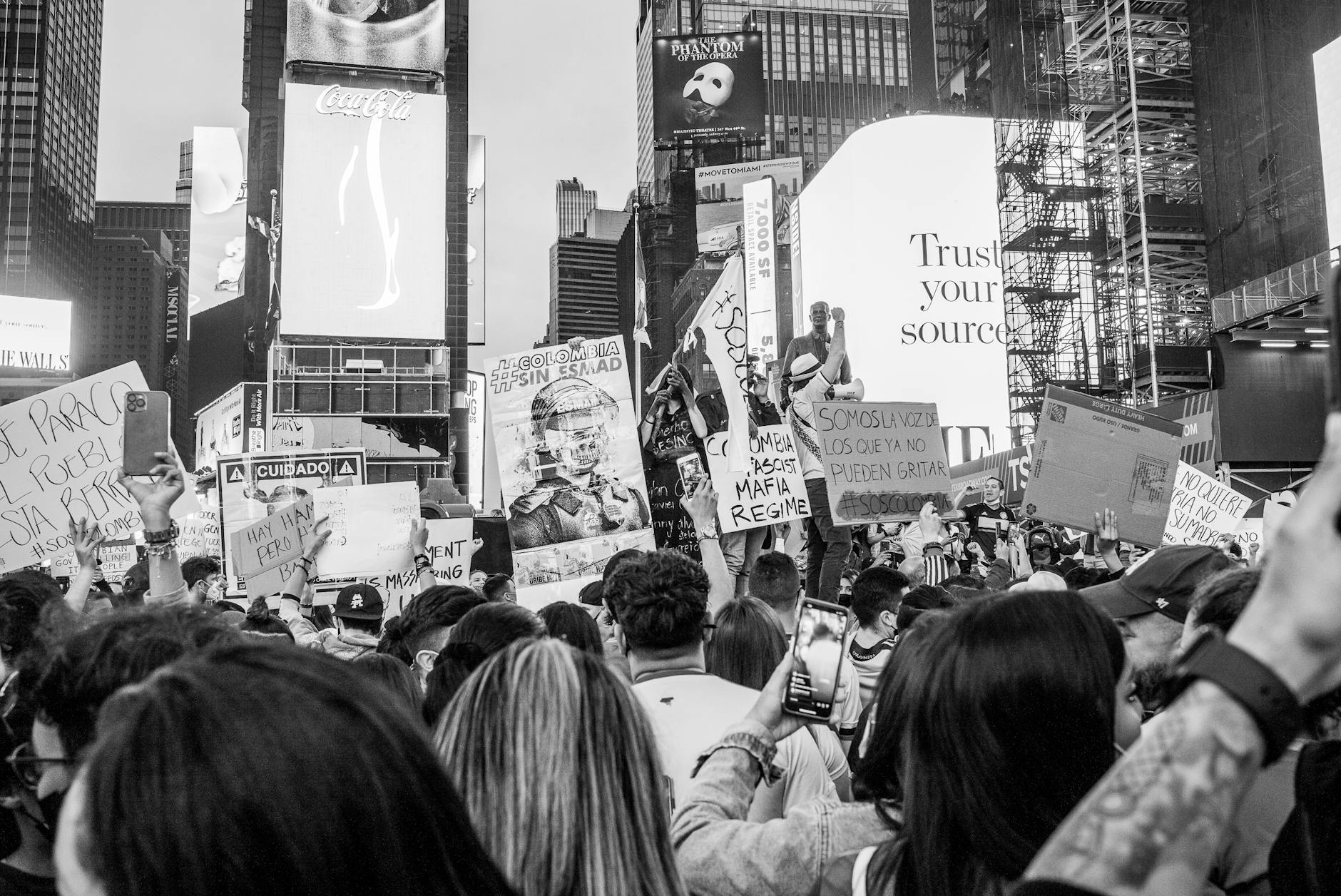
Bruguera’s Tatlin’s Whisper #6 in Times Square on May 1, 2026 (co-organized by Times Square Arts and the Fall of Freedom initiative), arrives at a critical juncture. It is not just a restaging of a 2009 work; it is a defiant statement that the fight for free speech is global—and that silence is complicity.
Why May 1?
– International Workers’ Day is a day of collective action, historically tied to labor rights and anti-capitalist struggle.
– In Cuba, May Day is a state-orchestrated spectacle, designed to project an image of unity that does not exist. Bruguera’s performance disrupts that narrative.
– In the U.S., the day serves as a reminder of the unfinished work of the labor movement—and the ways in which capitalism and authoritarianism often intersect.
Bruguera’s message is clear: “Freedom of expression is taken each time silence feels safer than speech.“
—
For Bruguera, art is not a luxury—it is a civic duty. In times of dictatorship, she argues, art must be political, even if that means sacrificing personal comfort or aesthetic preferences.
What does this look like in practice?
“This is a long-distance race.” The struggle for justice is not won in a single protest or performance. It requires relentless commitment—even when progress seems impossible.
Persistence is about endurance; insistence is about refusing to be silenced. Bruguera’s work often involves repetition and adaptation, testing the boundaries of what is possible.
Power understands the language of force—but it often fails to comprehend subversive creativity. Whether through performance, visual art, or digital media, artists must develop new ways of communicating resistance that evade censorship.
The Fall of Freedom initiative exemplifies this principle. When institutions like the Venice Biennale jury resign in protest of complicity with oppressive regimes, artists must recognize that prestige is not neutral. Sometimes, the most powerful act is to withdraw participation.
Bruguera’s advice to the next generation of activists and artivists:
“You have to keep going, even harder, after the administration changes, to restore what has been eliminated.“
—
In 2015, the Solomon R. Guggenheim Museum acquired Tatlin’s Whisper #6 for its permanent collection. At the time, Bruguera jokingly told the curators: “This piece cannot be performed in the United States. It can only be done if one day there is a dictator.“
The joke, of course, was that the work was about to be restaged in Times Square—proof that the boundaries between “here” and “there” are fiction. Art that begins in Cuba or Venezuela does not stay there. It travels, it evolves, it becomes a tool for global solidarity.
What does this mean for the U.S.?
– Art is a canary in the coal mine. When museums and galleries are pressured to self-censor, when artists are blacklisted for dissent, it is a sign that democracy is under threat.
– Artists are the first line of defense. Their work exposes the myths that sustain oppression—whether the myth of American exceptionalism or the myth of Cuban socialist utopia.
– Art is not neutral. To claim that art should be “apolitical” is to side with the oppressor. As Bruguera puts it: “In these moments, art must be political.“
—
Bruguera’s work is a call to action—not just for artists, but for everyone. In a world where misinformation, surveillance capitalism, and authoritarian populism are on the rise, art offers a radical alternative:
Whether through documentary film, protest art, or conceptual performance, artists uncover hidden realities that governments and corporations would prefer to keep buried.
Trauma is a tool of oppression. Art—whether in the form of music, theater, or visual storytelling—helps communities process pain and imagine alternatives.
From Ai Weiwei’s activism in China to Pussy Riot’s protests in Russia, art has sparked movements that changed history.
As Bruguera notes, her work is often a “rehearsal for the future.” It asks: What if we lived in a world where free speech was not conditional? Where dissent was not criminalized? Art allows us to practice utopia.
—
Tania Bruguera’s Tatlin’s Whisper #6 is more than a performance—it is a manifestation of hope in the face of despair. In a world where democracy is in retreat, where artists are persecuted, and where the very idea of truth is under attack, her work reminds us that art is not a luxury—it is a necessity.
The Cuban regime, the U.S. government, and authoritarian movements worldwide want us to believe that silence is safety. But Bruguera’s performances prove the opposite: silence is complicity.
As we stand on the precipice of a new era—one where the boundaries between art and activism, between freedom and control, are increasingly blurred—her message is urgent:
Art must be political.
Freedom must be fought for.
And solidarity must transcend borders.
—
– Art is a thermometer of power. It does not create change; it exposes the conditions that demand change.
– Dictatorships fear artists because art reveals their weaknesses. When a regime arrests an artist for speaking freely, it admits that its power is not absolute.
– Art must be political in times of crisis. To claim otherwise is to side with oppression.
– Solidarity is global. The struggles of Cubans, Americans, Venezuelans, and others are interconnected—not identical, but deeply related.
– Persistence and insistence are key. Change is not won in a day; it requires relentless commitment.
– Art is a rehearsal for utopia. It allows us to imagine—and practice—a better world.
—
– Tania Bruguera’s Official Website: [www.taniabruguera.com]
– Fall of Freedom Initiative: [www.falloffreedom.org]
– Cuban Independent Journalism: (https://www.14ymedio.com), (https://www.cubanet.org)