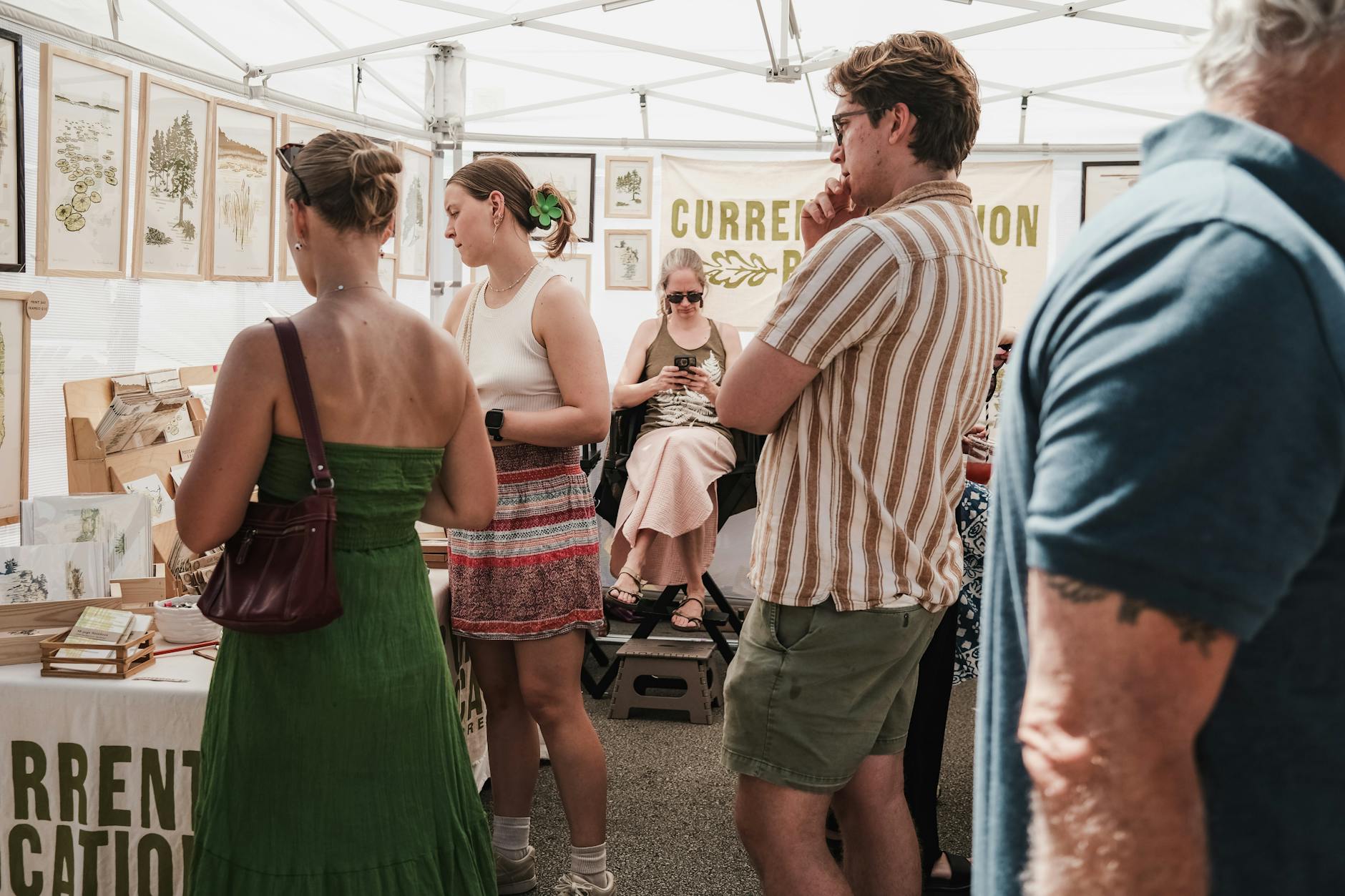
The Brooklyn Fine Art Print Fair (BFAPF) has swiftly evolved from its inaugural “beta” iteration into a must-attend event for printmaking enthusiasts, artists, and collectors. Hosted at the historic Powerhouse Arts in Brooklyn, this year’s fair—running through Sunday, April 12—has transformed into a vibrant hub of experimental printmaking, blending tradition with avant-garde innovation. With over 60 exhibitors spanning local artisans, international publishers, academic printmaking departments, and self-represented artists, BFAPF 2024 is not just an art fair; it’s a cultural manifesto redefining the boundaries of the medium.
The fair’s growth reflects a global resurgence of interest in printmaking, a discipline once sidelined in favor of digital and installation art. Yet, at BFAPF, printmaking is alive, evolving, and fiercely relevant. From layered screenprints to handmade paper sculptures and protest art, the fair is a testament to print’s power to interrogate history, identity, and social justice.
Unlike conventional art fairs, BFAPF distinguishes itself through:
Walking through BFAPF 2024 is like navigating a living archive of printmaking’s past, present, and future. Below, we spotlight some of the fair’s most visually arresting and conceptually layered works, each offering a glimpse into the radical potential of print.
At the Shoestring Press booth, the TUG Collective—comprising artists Gaelyn and Gustavo Aguilar—unveiled Shape Shift, a layered screenprint on plexiglass illuminated by an LED light. The work is part of their ongoing series, Don’t Forgive My Hands, inspired by Yusef Komunyakaa’s 2008 poetry collection Warhorses, which explores humanity’s weaponization of objects and animals.
The source image depicts men on horseback clad in combat equipment, but the horses themselves are stripped from the composition. Only the men’s appendages remain, symbolizing their role as the instruments of violence. The plexiglass layers invite viewers to peer through time and memory, while the LED light casts a haunting glow, evoking both transparency and opacity.
The Aguilars explained the work’s deeper meaning: “This piece is about legacy—how we inherit systems of violence and what it means to dismantle them.” The layered plexiglass references the Seventh Generation Principle, a Haudenosaunee philosophy that emphasizes long-term thinking and intergenerational responsibility.
At the Reading Road Studio booth, Maryland-based sculptor June Linowitz presented molded abaca paper renditions of extinct and critically endangered species. These dangling paper sculptures—meant to resemble trophy rugs or roadkill—are a visceral response to biodiversity loss and human-induced extinction.
Linowitz’s work is part of a broader trend at BFAPF: the elevation of paper as a medium of protest and remembrance. As artist and curator Helen Frederick (founder of Reading Road Studio) noted, BFAPF’s juried focus ensures that conceptual depth trumps commercial appeal—a rarity in today’s art fair landscape.
Arguably the fair’s most poignant and socially engaged work, The Papermaker’s Suite is a collaboration between master printer Ruth Lingen (of Line Press Limited) and poet-regionalist Reginald Dwayne Betts, a 2021 MacArthur Fellow and prison reform advocate.
The project began with Lingen creating paper from socks, sweatpants, and towels donated by Betts’s incarcerated friends. Betts then printed his poetry on these sheets, transforming discarded materials into a testament to resilience. The result is a palimpsest of suffering and hope, where the tactile history of the fabric intertwines with Betts’s lyrical defiance.
As Lingen paged through the blank sheets, she remarked: “Every fiber carries a story. Every word carries a voice.” The work’s presence at BFAPF underscores the fair’s role as a platform for art that challenges systemic injustice.
Iranian-American artist Golnar Adili presented a book-bound diptych that is as conceptually audacious as it is visually striking. A Thousand Pages of Chest in a Thousand Mirrors (2024) features prints of Adili’s breasts, from which she carved out the valley between them and rearranged the excised paper to mimic the sloping silhouette of Tehran’s Azadi Tower.
When the book is closed, the excised “flesh” nestles back into Adili’s body, symbolizing healing, fragmentation, and reconstruction. The work explores feminine identity, displacement, and the act of claiming space—themes that resonate deeply in today’s global conversations about body autonomy and cultural heritage.
Austria’s Viadukt Screen Prints brought a refreshing focus on monotype and folded screen printing to BFAPF 2024. Artist Michael Wegerer demonstrated Folded Figures Explosion X (2026), a series where he pre-designed folding patterns on screens before applying ink with a paintbrush. The result is a dynamic interplay of geometry and spontaneity, where the folds create “a sense of movement and rupture”.
Wegerer’s work exemplifies BFAPF’s embrace of process-driven art, where the artist’s hand and the medium’s unpredictability are celebrated over commercial perfection.
While BFAPF 2024 has undeniably taken its training wheels off, the fair is not without its growing pains. Here’s a balanced look at its strengths, criticisms, and areas for improvement:
In an era dominated by NFTs, AI-generated art, and immersive digital experiences, printmaking might seem like a “retro” medium. Yet, BFAPF 2024 proves that print is more vital than ever—not despite its traditions, but because of them. Here’s why:
Print has long been a weapon of the marginalized. From protest posters in the Civil Rights Movement to zines in the punk scene, print empowers communities to distribute ideas rapidly and cheaply. At BFAPF, this legacy lives on in works addressing Palestinian liberation, Indigenous rights, and prison abolition.
As curator Helen Frederick noted, “Printmaking is inherently democratic. It’s about multiples—about making art accessible to everyone, not just the elite.”
In a world of digital overload, print offers a sensory counterpoint. The weight of a handmade paper, the ink’s scent, the “ghosting” of a monotype—these qualities create a deep, embodied connection with the artwork. Works like The Papermaker’s Suite and Linowitz’s sculptures exemplify how print can transform the tactile into the transcendent.
The fair’s emphasis on historical narratives and intergenerational responsibility (e.g., TUG Collective’s Shape Shift and the Seventh Generation Principle) highlights print’s power to archive and interrogate the past. In an era of cultural erasure and misinformation, printmaking serves as a guardian of truth.
Whether you’re a collector, artist, or first-time attendee, here’s how to navigate the fair like a pro:
As BFAPF continues to gain momentum, the question on everyone’s lips is: What’s next? Based on the fair’s trajectory, here are some potential developments to watch for in 2025:
Could BFAPF introduce a virtual component? A hybrid model—combining in-person exhibits with online artist talks, print sales, and virtual tours—could democratize access and attract a global audience.
The fair’s 2024 focus on social justice and environmentalism could evolve into a biennial themed edition, such as “Print and Protest” or “Eco-Print: Art in the Age of Climate Crisis”.
Imagine a printmaking and music festival, where visual art intersects with live performances, or a print and poetry symposium featuring Reginald Dwayne Betts and other literary voices.
As the art world grapples with its environmental impact, BFAPF could lead by example, introducing recycled paper standards, carbon-neutral shipping options, or upcycling workshops for artists.
The Brooklyn Fine Art Print Fair is more than a showcase—it’s a revolution in how we experience art. By prioritizing conceptual depth, social engagement, and innovation, BFAPF has set a new standard for what art fairs can—and should—be. Whether you’re a printmaking purist, a social justice advocate, or simply a lover of beauty and provocation, there’s something at BFAPF for you.
As we look ahead to 2025 and beyond, one thing is clear: Printmaking is not just alive—it’s thriving, evolving, and fighting back. And Brooklyn, with its rich artistic legacy and unapologetic spirit, is the perfect home for this renaissance.
Don’t miss your chance to be part of it. Mark your calendars, bring your curiosity, and prepare to be inspired.
✅ A global hub for printmaking’s avant-garde, blending tradition with radical innovation.
✅ Socially engaged art that addresses Palestinian liberation, prison reform, and environmentalism.
✅ Unparalleled diversity of exhibitors, from independent artists to academic departments and international publishers.
✅ A multi-sensory experience that celebrates the tactile and the ephemeral.
✅ A model for the future of art fairs, prioritizing conceptual depth and community over commercialism.
Want to dive deeper into the world of printmaking? Check out these essential reads, exhibitions, and organizations:
[Your Name] is a [your title, e.g., art critic, curator, or writer] specializing in [your areas of expertise, e.g., contemporary printmaking, socially engaged art, or digital media]. With [X] years of experience in the art world, [Your Name] has contributed to publications such as [list relevant publications or platforms]. Their work focuses on [your themes, e.g., the intersection of art and activism, the history of printmaking, or emerging artists pushing boundaries].
Follow [Your Name] on [social media handles or website] for more insights into the art world.